Institut Ruiz Castilla · Reconstructive surgery
Mohs surgery and facial reconstruction
Coordinated planning of facial skin cancer removal and reconstruction.
Patient information
Assessment, treatment and care
01Your initial assessment
Most patients come to us following a dermatology assessment, with either a biopsy result or a clinically suspicious skin lesion. We review the available information and any investigations needed to confirm the diagnosis and select the appropriate treatment.
We may mark the lesion on the skin and explain the possible extent of the defect, the reconstruction options, the expected scars and recovery.
02Margin assessment and reconstruction
The tissue is carefully mapped, and both the peripheral and deep margins are examined. If tumour remains, further tissue is removed from the corresponding area.
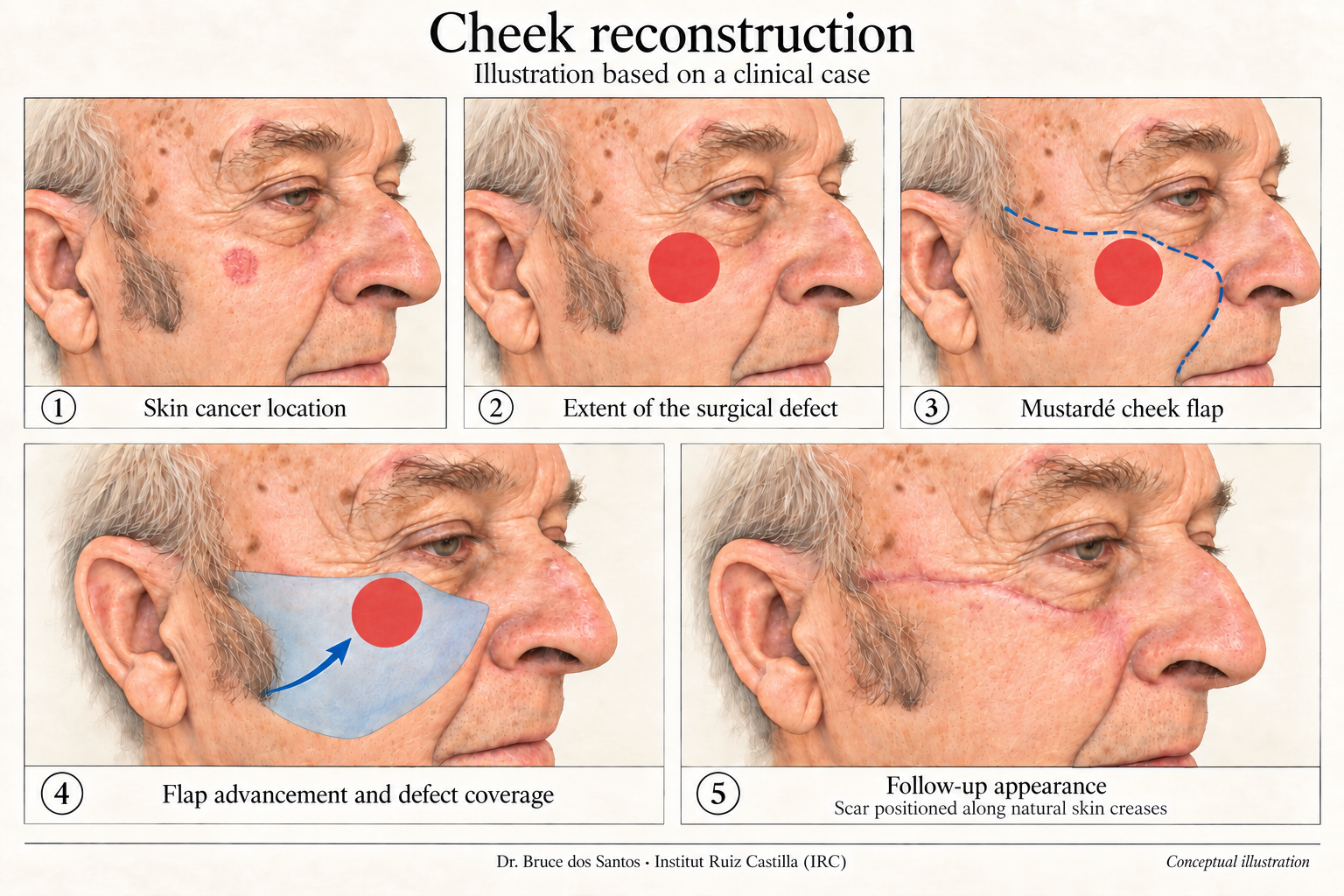
Once examination during surgery confirms clear margins, we assess the defect and select the appropriate reconstruction. This may involve direct closure, a skin graft or a local flap.
At Institut Ruiz Castilla (IRC), we coordinate tumour removal and reconstruction so that both can take place during the same procedure whenever conditions allow. The reconstructive technique is tailored to the size, depth and location of the defect.
03Anaesthesia and hospital stay
Procedures involving a straightforward closure or a small skin graft may be performed under local anaesthesia. More extensive flap reconstruction may require sedation or general anaesthesia.
At Institut Ruiz Castilla (IRC), the team considers your health, preferences and the complexity of the procedure when planning same-day discharge or a hospital stay.
04Early postoperative care
Keep the treated area clean and dry until the team explains when and how you may wash it. Use only the products prescribed for you, particularly around the eyes.
We usually recommend sleeping with your head elevated and avoiding pressure or unnecessary handling of the treated area.
05Wound care and stitches
The nursing team at Institut Ruiz Castilla (IRC) provides wound care under medical supervision, with frequent reviews during the early stages of recovery.
Facial stitches are generally removed earlier than stitches elsewhere on the body, often after a few days. The timing depends on the location and how the wound is healing.
06Healing and follow-up
It takes several months to assess a stable result. Some changes improve without further surgery, so it is often best to allow time for healing before considering a revision.
If a problem progressively worsens or affects function—for example, difficulty closing the eye because of scar tightening—we assess whether earlier treatment is needed. Eye pain or changes in vision require immediate medical attention.
07Ongoing dermatology care
Your dermatology team monitors for recurrence and new skin lesions. At Institut Ruiz Castilla (IRC), we monitor wound healing, scars and reconstruction until your surgical follow-up is complete. Clinical records are shared within the hospital.
Completing surgical follow-up does not replace your dermatology checks. If concerns arise, your dermatologist can refer you back to the plastic surgery team.
08Scar care
Sun protection, moisturising and scar massage are introduced once the team confirms that the wound has healed sufficiently. Silicone sheets or gel may be recommended depending on the area, the surgical technique and how healing progresses.
Care continues until the scars have matured clinically. Scars do not all mature at the same rate, even in the same person. If a scar becomes raised, firm, itchy or develops unfavourably, the Institut Ruiz Castilla (IRC) team will assess whether specific treatment is needed.
09If you are concerned, contact the team
Contact us if you notice increasing pain, persistent bleeding, a rapid change in swelling, spreading redness or increasing warmth, fever, discharge, wound opening or any other change that concerns you. You do not need to decide whether it is a complication: the team will assess it.
Institut Ruiz Castilla (IRC) provides on-call medical support 24 hours a day, seven days a week. Medical and administrative contact numbers are included in your care instructions.
If you experience difficulty breathing, chest pain, fainting or another clear emergency, seek urgent medical attention rather than waiting for a scheduled appointment.
References and clinical guidelines
Bibliography for this clinical topic. References are grouped for the page as a whole, rather than attached to individual sentences. The sources inform the general information; individual care and follow-up are tailored by the Institut Ruiz Castilla (IRC) team.
Guideline or consensus
European consensus-based interdisciplinary guideline for diagnosis and treatment of basal cell carcinoma-update 2023.Peris K, Fargnoli MC, Kaufmann R et al. · European journal of cancer (Oxford, England : 1990) · 2023 · DOI: 10.1016/j.ejca.2023.113254
Guideline or consensus
European consensus-based interdisciplinary guideline for invasive cutaneous squamous cell carcinoma: Part 2. Treatment - update 2026.Stratigos AJ, Dessinioti C, Garbe C et al. · European journal of cancer (Oxford, England : 1990) · 2026 · DOI: 10.1016/j.ejca.2026.116764
Guideline or consensus
European consensus-based interdisciplinary guideline for invasive cutaneous squamous cell carcinoma. Part 1: Diagnostics and prevention - Update 2026.Stratigos AJ, Dessinioti C, Garbe C et al. · European journal of cancer (Oxford, England : 1990) · 2026 · DOI: 10.1016/j.ejca.2026.116763
Clinical study
Approaches to Cheek Reconstruction following Mohs Surgery.McAllister L, Thornton JF. · Seminars in plastic surgery · 2024 · DOI: 10.1055/s-0044-1791223
Guideline or consensus
Evidence-Based Clinical Practice Guidelines: Reconstruction After Skin Cancer Resection; Autologous Breast Reconstruction with DIEP or Pedicled TRAM Abdominal FlapsAmerican Society of Plastic Surgeons
Bibliography checked: 28 September 2026. Original publication titles are retained.